Buyer's guides · Tender process
What does a commercial solar tender involve, step by step?
The six steps from energy assessment to appointment, and what each one puts in front of your board.
 Written by Harry HainesCEO & Co-Founder, CH Group
Updated · 8 min read
CH Group runs controlled solar tenders for commercial sites of 100 kWp and above.
The short answer
A commercial solar tender is a controlled competition. One brief, one verified set of data and the same assumptions go to several installers, and their proposals come back on one basis so your board can compare them. It suits a site of 100 kWp or more where you have no trusted installer yet.
CH Group runs the tender end to end in six steps and three phases: assess; tender; then decide and deliver. It starts from twelve months of half-hourly data, checked before anyone quotes, and ends with one board-ready recommendation. A whole project usually takes 2 to 4 months from first enquiry to switch-on on a straightforward site 6.
Figures checked · Process steps match chgroup.co.uk on 16 November 2026.
Key numbers
| Figure | Source | |
|---|---|---|
| Official price data above 50 kW | None; the DESNZ median for 10 to 50 kW is £1,262 per kW | DESNZ, 28 May 2026 1 |
| Scope of MCS certification | Up to 50 kWp DC | MCS, 1 Jan 2025 3 |
| Installed price, 100 to 500 kWp, ex-VAT | £700 to £1,050 per kWp | Spirit Energy, 2026 2 |
| Baseline checked before anyone quotes | Twelve months of half-hourly data | CH Group process |
| Variables every proposal is compared on | Ten | CH Group process |
| DNO offer standard, low or high voltage works | 45 or 65 working days | SSEN, April 2026 5 |
| Survey to contract award, Kelston Sparks (116 kWp) | 22 days | CH Group project |
What goes wrong when a business buys solar without a tender, and what does it cost?
The usual mistake is to take a single installer's proposal at face value, so the board approves a price and a yield that nobody has tested against anything.
The board is asked to approve a proposal, and you are the one who has to say whether it is a good one. Usually it looks reasonable, and the decision gets made on one set of assumptions. The risk is not that the installer is dishonest. It is that you have nothing to measure the proposal against.
- There is no official benchmark. DESNZ publishes cost data only up to 50 kW, at a median of £1,262 per kW for 10 to 50 kW systems in 2025/26 1. Above that, the public ranges come from installers.
- The usual quality mark stops at 50 kWp. MCS certification covers systems up to 50 kWp DC 3, so on a 100 kWp roof you check accreditation and warranty backing yourself.
- Headline prices leave things out. One lead-generation site lists scaffold at £1,200 to £3,000, a structural survey at £500 to £2,000 and DNO fees at £1,000 to £10,000 or more as items often missing from a headline price 4.
- Each installer uses its own assumptions. Yield, self-consumption and scope differ, which makes quotes hard to compare. Our guide to comparing commercial solar quotes lists the ten variables to put on one basis.
- The grid decides the date. The network operator has 45 working days to issue an offer where only low voltage works are needed, and 65 where high voltage works are involved 5. See how long commercial solar takes.
The cost is a project priced and scoped on assumptions you could not see. A tender is how you put the same questions to several installers and see the answers side by side.
What are the six steps of a commercial solar tender?
A tender runs through energy assessment, project definition, a controlled tender, proposal comparison, a recommendation, and appointment and delivery, and CH Group runs all six while you follow each step live in your own tender portal.
The six steps fall into three phases. You stay in control throughout.
| Phase and step | What happens |
|---|---|
| Assess: 1. Energy assessment | We review your bills, half-hourly data, operating hours and site. |
| Assess: 2. Project definition | We set site constraints, objectives, target system and funding route. |
| Tender: 3. Controlled tender | One consistent brief goes to selected, vetted EPC partners. |
| Tender: 4. Proposal comparison | Every proposal is normalised on the same key variables. |
| Decide and deliver: 5. Recommendation | We present the strongest options, the trade-offs and the preferred route. |
| Decide and deliver: 6. Appointment and delivery | We support final selection, survey handover and the move into delivery. |
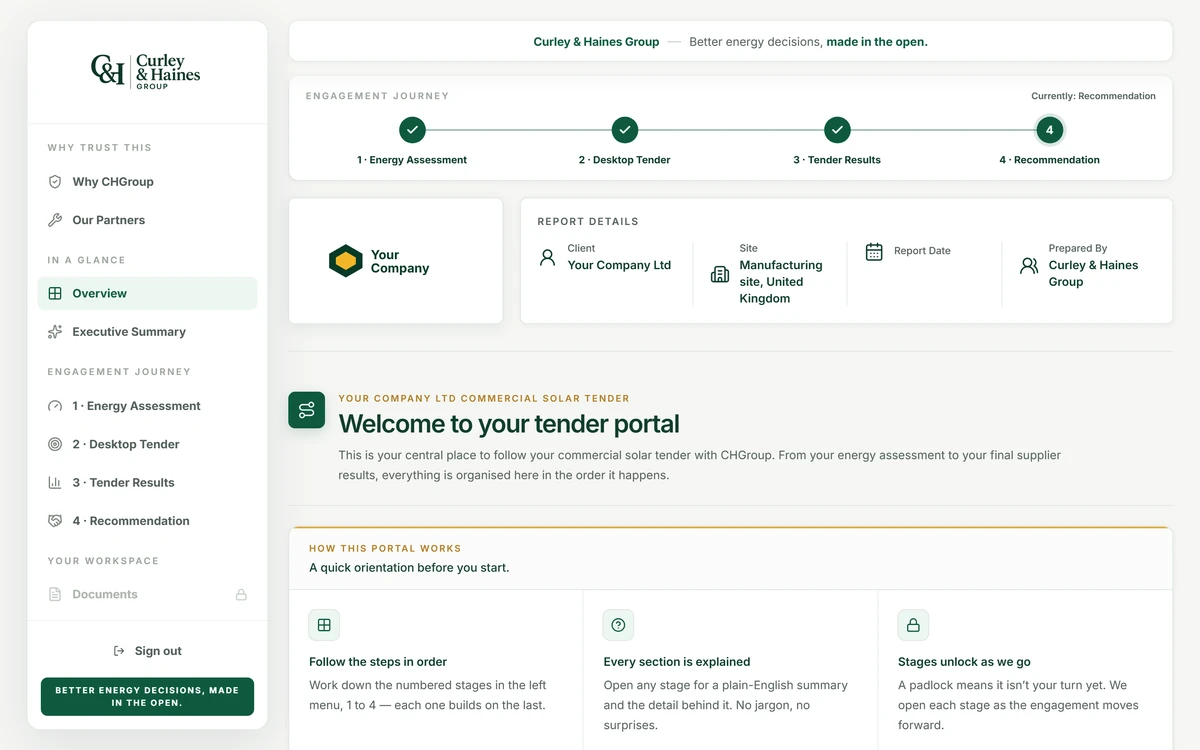
Throughout, you follow every step in your own secure tender portal. Only the people you name can see it, and installers never see each other's quotes. It replaces the spreadsheets, email chains and PDF quotes that a self-run process produces.
Why does a tender start with twelve months of half-hourly data?
A tender starts from twelve months of half-hourly data, checked before anyone quotes, so every installer quotes on the same assumptions.
Generation, self-consumption, savings and payback all depend on when your site uses electricity, not just how much it uses in total.
Every installer then quotes on the same assumptions. Our guide to payback and return explains why the share of power you use on site drives the result.
What does the comparison cover?
The comparison puts every proposal on the same ten variables, and compares the funding routes of capex, asset finance and a power purchase agreement (PPA) side by side.
The ten variables are:
- System size: the kWp proposed for your roof and demand.
- Generation: expected annual output, on one basis.
- Self-consumption: how much of the power your site actually uses.
- £/kWp: the installed price per kilowatt peak.
- Equipment: panels, inverters and mounting, by manufacturer.
- Warranties: product, performance and workmanship cover.
- Savings: annual savings on your verified tariff.
- Payback: the years to recover the investment.
- Programme: time on site and the delivery plan.
- Commercial terms: deposit, payment stages and contract terms.
Funding is compared as a structure as well as a system: cash flow, ownership, savings, contract term and suitability. A PPA term is typically 10 to 25 years 9. Our funding guide sets out the three routes, and the tax points to check with your accountant 8.
Which public figures can you test a tender against?
Public sources give price ranges, project durations, planning rules and tax allowances that you can use to sense-check any proposal, though most are installer figures and the dates differ.
These are public figures, as published on the dates shown. They are a check, not a quote. Your site decides the real numbers.
| Item | Public figure | Source and date |
|---|---|---|
| Installed price, 100 to 500 kWp, ex-VAT | £700 to £1,050 per kWp, falling as size rises | Spirit Energy, 2026 2 |
| Whole project, straightforward site | 2 to 4 months from enquiry to switch-on | EvoEnergy, updated 31 Aug 2026 6 |
| DNO offer standard | 45 working days (low voltage works), 65 (high voltage works) | SSEN, April 2026 5 |
| Planning, England | Most non-domestic rooftop solar is permitted development; 56 days of prior approval for solar PV that is not microgeneration | Planning Portal, accessed 13 Nov 2026 7 |
| Annual Investment Allowance | £1 million | HMRC, 6 Apr 2026 8 |
| First-year allowance on solar (companies) | 50%, as special rate plant, not full expensing | HMRC, 6 Apr 2026 8 |
| VAT on commercial solar | 20%; 0% is residential and charitable only | HMRC, 31 Jan 2024 10 |
| National grant | None for commercial rooftop solar; the UK Shared Prosperity Fund grant closed on 31 March 2026 | Enterprise Nation, 17 Mar 2026 11 |
Confirm every tax point with your accountant. Our guides to cost, site suitability and funding give the sources behind each figure.
How long does a tender take, and what does it cost you?
A tender adds time before contract award, and CH Group's fee is agreed in writing before you commit to anything.
At Kelston Sparks, a 116 kWp project, the contract was awarded 22 days after the site survey. That is one project, not a promise for yours. The timeline depends on your site, your data and the installers, and the grid connection still sets the switch-on date. See how long commercial solar takes.
CH Group's fee is agreed in writing before you commit to anything, and its installer partners also pay CH Group. We do not publish a fee on this page. Ask any adviser, CH Group included, who pays them and for the full terms in writing. Our guide to installer, broker or consultant compares the routes.
When is a tender not the right route?
A tender is not the right route for a small or simple system, for a buyer who already holds comparable quotes and trusts an installer, or for a site where the landlord has not consented.
- Small or simple systems. A controlled tender earns its place on larger sites. For a small or simple system, going direct to a reputable installer is usually proportionate.
- Quotes already in hand. If you hold comparable proposals and trust one installer, a tender adds time. We can put existing quotes on a single basis if you want a check, but you do not need to run a tender.
- Roof rights not settled. If you lease the building and your landlord has not consented, settle that first. See the site suitability guide.
CH Group project: projected figures
Kelston Sparks: three comparable proposals for a 116 kWp roof
Earlier solar enquiries had left Kelston Sparks, a plant and machinery hire business in Bristol, without a common basis for comparison. A structured tender gave it three suitable contractors, one consistent brief and three comparable proposals.
All three contractors visited the site before the business chose its installer. The contract was awarded 22 days after the site survey. The 116 kWp system has a projected annual saving of £20,075 and a projected payback of 2 years 10 months. Projections depend on the site's energy use, tariff and system, and are estimates, not promises. See the projects page for the full case.
Before a tender: four things only you can do
Gather your data Ask your electricity supplier for twelve months of half-hourly data and gather your recent bills. Every proposal depends on them.
Define what you want the tender to answer Note your objectives, any site constraints and whether you would consider buying outright, financing or a PPA.
Settle roof rights early Confirm who owns or controls the roof, and get your landlord's consent if you lease.
Ask every adviser who pays them Get the answer, and the full terms, in writing before you commit to anything.
How CH Group handles this
We run the whole tender for you, end to end. We start with twelve months of half-hourly data, checked before anyone quotes, then send one consistent brief to our panel of vetted installers. Every proposal is compared on the same ten variables, and funding routes are compared side by side. You then receive one board-ready recommendation, with the numbers in your own tender portal.
Our fee is agreed in writing before you commit to anything, and installer partners also pay CH Group. Every partner bids against the same brief, so no installer can buy a better place in your comparison. Savings are projected, and we do not give regulated financial or tax advice. If the tender says you should not proceed, that is the recommendation.
To see a first indication for your site, try the savings calculator. When you are ready, book a call.
Questions buyers ask next
What is a commercial solar tender?
A commercial solar tender is a controlled competition between installers. One brief and one verified set of data go to several installers, and their proposals are compared on the same variables, so the buyer can choose on a like-for-like basis.
How long does a commercial solar tender take?
It depends on your site, your data and the installers. At Kelston Sparks, a 116 kWp project, the contract was awarded 22 days after the site survey. A whole project usually takes 2 to 4 months from enquiry to switch-on on a straightforward site, and the grid connection sets the switch-on date.
What data do I need before a tender?
Twelve months of half-hourly electricity data, checked before anyone quotes, and your recent bills. Ask your electricity supplier for the half-hourly data. See our timeline guide for what to ask for.
What does a commercial solar tender cost?
CH Group's fee is agreed in writing before you commit to anything, and its installer partners also pay CH Group. We do not publish a fee on this page, so ask for the full terms in writing.
Which funding routes does a tender compare?
Capex, asset finance and a power purchase agreement (PPA), side by side. A PPA term is typically 10 to 25 years. All funding routes are subject to suitability and funder terms.
Is a tender worth it for a small system?
Usually not. A controlled tender earns its place on larger sites, from about 100 kWp. For a small or simple system, going direct to a reputable installer is usually proportionate.
Sources
Public figures are from the sources below, as published on the dates shown. CH Group project figures are projections supplied for each case study. This guide is general information, not financial, tax or legal advice.
- DESNZ, Small-scale solar PV cost data 2025-26, 28 May 2026.
- Spirit Energy, Commercial solar cost, payback and ROI, 2026.
- MCS, The Solar PV Installation Standard (MIS 3002), 1 Jan 2025.
- Business Solar Check, How to compare commercial solar quotes (12-point checklist), June 2026.
- SSEN, Metered Connections GSoPs (performance standards 2026), April 2026.
- EvoEnergy, What to expect during a commercial solar power installation project, Updated 31 Aug 2026.
- Planning Portal, Planning Permission: Solar panels mounted on a non-domestic building, Accessed 13 Nov 2026.
- HMRC, Capital allowances and balancing charges (HS252), 2025, 6 Apr 2026.
- Solar Energy UK, Power Purchase Agreements, Accessed 13 Nov 2026.
- HMRC, VAT on energy-saving materials and heating equipment (Notice 708/6), 31 Jan 2024.
- Enterprise Nation, Is the UK Shared Prosperity Fund replacement adequate?, 17 Mar 2026.